Plenty of business owners have a website they think looks great and quietly assume it’s doing its job. But pretty doesn’t pay the bills. Here’s how to tell whether your site is actually earning its keep, or just sitting there.
Think in terms of a funnel
A website that works isn’t one thing — it’s a chain of steps, and revenue falls out the bottom. Picture it as a funnel:
- Traffic. People arrive at your site.
- Leads. Some of them take an action — a call, a form, a booking.
- Customers. Some of those leads become paying customers.
- Revenue. Those customers are worth actual money.
The point of thinking this way is that a weak result at the bottom always traces back to a specific step. Lots of traffic but no leads? The site isn’t converting. Plenty of leads but little revenue? Maybe the wrong kind of visitor, or a sales gap after the click. You can’t fix what you can’t locate, and the funnel tells you where to look.
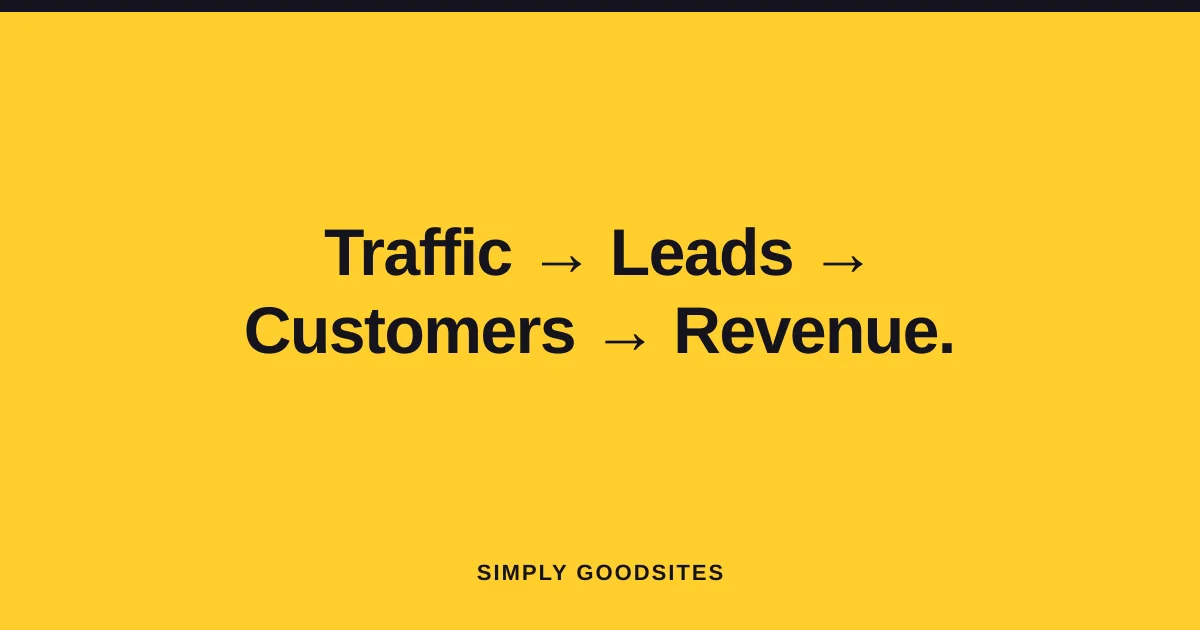 The whole game: traffic to leads to customers to revenue.
Vanity metrics vs. real ones
The biggest trap is measuring things that feel good but mean nothing for your business.
Vanity metrics look impressive and change nothing:
- Raw pageviews with no context.
- Total visitors who never do anything.
- “Impressions” from social or ads.
- Time on site, on its own, tells you little — it could mean engaged, or lost and confused.
Real metrics connect to money:
- Leads generated — calls, forms, bookings.
- Conversion rate — the percentage of visitors who become leads.
- Cost per lead — what you spend to get one.
- Revenue you can trace back to the site.
A site getting 10,000 visitors and zero calls is losing to a site getting 300 visitors and 15 calls. Volume is not the goal. Business is.
What to actually track
You don’t need a dashboard with fifty numbers. Track these and you’ll know where you stand:
- Phone calls from the website. If the phone is your main channel, this is the number that matters most.
- Form fills and bookings. Count every completed contact form, quote request, or appointment.
- Conversion rate. Leads divided by visitors. Even a rough figure tells you whether the site persuades people or just hosts them.
- Cost per lead. If you’re running ads, divide spend by leads. This is the number that tells you whether the marketing is working.
- Top landing pages. Which pages actually bring people in and convert them? Double down on what works.
- Traffic source. Are visitors coming from Google search, ads, social, or direct? Each says something different about your reach and your local SEO.
Simple, free tools to see it
You do not need expensive software to measure any of this:
- Google Analytics 4 (GA4) — free, and shows traffic, sources, top pages, and conversions once you set up events for your forms and calls.
- Google Search Console — free, and shows what people searched to find you and where you rank. Essential for understanding organic traffic.
- Call tracking — a service that gives you a special phone number so you know exactly which calls came from the website. Worth it if the phone is your lifeline.
Set these up once and they quietly collect the truth in the background.
Set a baseline, then judge
Here’s the honest part about “good” numbers: there’s no universal benchmark, because a plumber, a dentist, and a law firm all play different games. Chasing someone else’s numbers is a distraction.
What matters is your own baseline. Write down where you are today (visitors, leads, conversion rate) and then watch the trend. Improvement against your own starting point is the only comparison that counts. A conversion rate climbing from 1% to 3% is a genuine win, whatever the “industry average” supposedly is.
As a loose sense of direction: a healthy small-business site usually turns a meaningful slice of its visitors into leads, not a rounding error. If your conversion rate is a fraction of a percent, something’s wrong. But treat that as a smell test, not a scoreboard.
Speed and clarity move the numbers
Two things quietly shape every metric above, and both come down to how the site is built.
Speed. A slow site loses people before they ever convert. Google’s research found 53% of mobile visitors abandon a page that takes more than 3 seconds to load. Every one of those is a lead that never had a chance. If your numbers are weak, speed is the first thing to check, and why is my website slow walks through the usual culprits.
Clarity. A confused visitor doesn’t convert. If it’s not instantly obvious what you do, who you serve, and how to contact you, people leave. Clear headlines, obvious buttons, and an easy path to a phone number or form do more for conversion than any clever design flourish.
Is it the site, or the traffic?
When the numbers disappoint, the funnel tells you which problem you have:
- Low traffic, decent conversion. The site works; you just need more of the right visitors. That’s an SEO and reach problem — better local search, more content, maybe ads. Start with the industries and locations you actually serve.
- Good traffic, poor conversion. People are arriving and leaving without acting. That’s a website problem — speed, clarity, trust, or a weak call to action.
- Both weak. Time for an honest rebuild rather than tinkering.
Diagnosing which one you’re facing saves you from spending money on the wrong fix — pouring ad budget into a site that can’t convert, or redesigning a site that just needs to be found.
Working out what a lead is actually worth
Most of this becomes concrete once you know one number: what a customer is worth to you. Without it, “is the website working” stays a feeling.
Three steps, and rough figures are fine.
1. Average job value. Take your revenue for the last twelve months and divide by the number of jobs. Not what you’d like to charge, what you actually averaged.
2. Close rate on website enquiries. Of the people who contact you through the site, what fraction become customers? Most service businesses land somewhere between a quarter and a half. If you don’t know, guess conservatively and refine later.
3. Multiply. Job value times close rate gives you the value of one enquiry.
If your average job is $800 and you close a third of website enquiries, each enquiry is worth roughly $267 to you.
That single number changes how every other decision looks:
- A $3,000 website pays for itself at twelve enquiries
- An ad campaign costing $150 per lead is profitable
- A slow page losing you four enquiries a month is costing $1,068 monthly
- Spending a day fixing your contact form is obviously worth it
Add repeat business and referrals and the real figure is usually higher. But even the conservative version is normally enough to make the right call obvious, which is the point.
Reading the numbers without fooling yourself
A few habits separate useful measurement from anxious dashboard-watching.
Compare like with like. Month against the same month last year where seasonality matters. A roofer comparing November to July learns nothing.
Watch the trend, not the point. Any single month is noisy. Three months moving in one direction is a signal.
Small samples lie. A page with 30 visits and one enquiry is not a 3.3% conversion rate. It’s one enquiry. Wait for volume before drawing conclusions.
Reconcile against reality monthly. Compare what analytics claims against the enquiries actually in your inbox. If they disagree badly, fix the tracking before trusting any of it. This is the single most valuable habit on this list, and almost nobody does it.
Beware the metric that only ever goes up. Cumulative totals always look encouraging. Rates and monthly figures tell you what’s actually happening.
Frequently asked
How long before a new website shows results? Conversion improvements show within weeks, because they affect visitors already arriving. Traffic growth from search takes months. Judge a new site on enquiries per visitor first, and rankings later.
What if I have almost no traffic? Then your problem is visibility, not conversion, and no amount of page optimisation fixes it. Start with local SEO and your Google Business Profile.
Is a high bounce rate bad? Not necessarily. Someone who lands on your contact page, reads your hours, and calls you is a success that looks like a bounce. GA4 replaced bounce rate with engagement rate for exactly this reason.
Should I track phone calls?
If phone is your main channel, yes. At minimum track taps on your tel: links. If you’re spending on ads, a dedicated tracking number is worth the cost.
How much should I spend measuring this? Nothing. Analytics and Search Console are free, and they cover everything described here. Tracking website leads in GA4 walks through the setup.
My website has never produced an enquiry. Where do I start? Test your contact form first, with a real submission, and check spam. A silently broken form is far more common than anyone expects and looks exactly like a site nobody wants to contact.
The one number to watch
If all of this feels like a lot, track a single figure: enquiries per month, and where they came from.
Everything else on this page is a way of explaining that number when it moves. Traffic tells you how many people arrived. Conversion tells you how persuasive the site was. Cost per lead tells you whether the marketing pays. But enquiries per month is the one that connects directly to whether the website is doing its job.
Write it down every month. Twelve numbers in a year will tell you more about your website than any dashboard.
The honest brand note
When we build a site, it’s built to be measured. You own everything (the code, the analytics, the data) with no lock-in and no black box. Local SEO is baked in from day one so the traffic side of the funnel has a real shot, and ongoing maintenance is available if you want the numbers watched over time. Before hiring anyone, it’s worth reading how to choose a web designer.
Find out where you stand
If you’re not sure whether your website is working, the answer is knowable — it just takes looking at the right numbers. Get in touch and we’ll help you read them honestly, or explore our services to see how we build sites designed to convert, not just to look good.
Want this handled for you?
SimplyGood builds fast, lead-generating websites for local businesses across the US. Get a tailored quote in one business day.